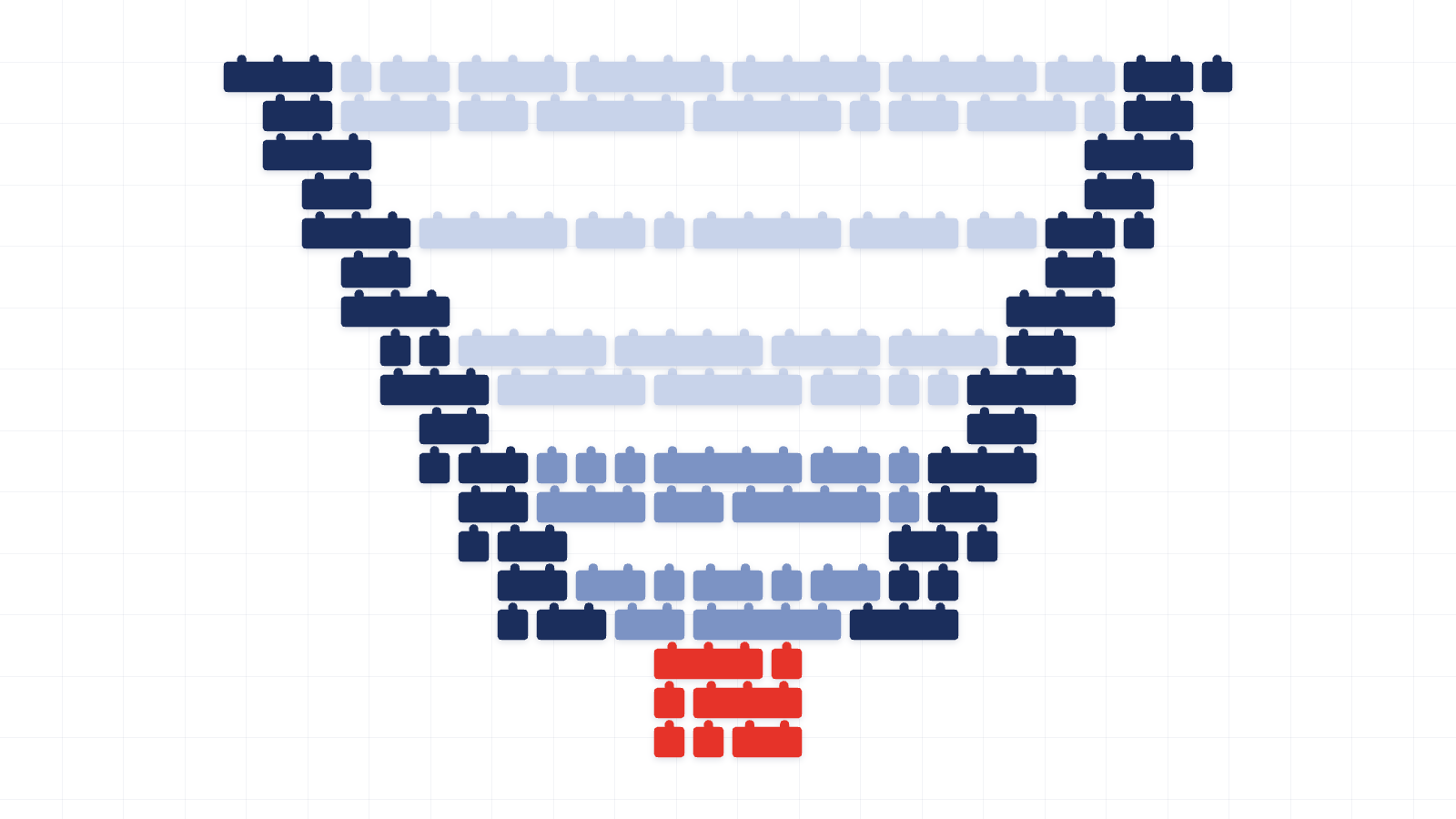
A B2B sales funnel is a measurement model, not a process. It describes how many contacts from a target market make it to a closed deal, and it exists to show you where the rest fall out. The most common failure is drawing a funnel that reflects how the team wishes buying worked: stages named after internal activity, transitions nobody can verify objectively, and a forecast that gets reinvented every month.
In this guide, we cover the stages a B2B funnel actually has, the two metrics per stage that carry real information, how to tell the two fundamentally different kinds of bottleneck apart, and why the difference between a funnel and a pipeline is more than vocabulary.
The Stages of a B2B Sales Funnel
The shape is easy to describe: many contacts with low intent at the top, few with high intent at the bottom. What matters is not how many stages you draw but how you define them. A stage only works as a measurement point if two people on your team, looking at the same contact independently, would put it in the same place.
There is a simple test for that. Can you tie the transition to something the buyer did, or only to something your team did? "Downloaded a whitepaper" describes an action, but tells you almost nothing about intent. "Attended a meeting they agreed to" describes behavior that cost the buyer time, which is why it means something. Stages built on your own activity end up measuring your own busyness, and they are the reason so many funnel reviews feel productive and change nothing.
Awareness and the Top of the Funnel
At the top, the question is how many qualified accounts learn you exist. In B2B this stage is usually scoped too narrowly, treated as a content and marketing job alone. In practice, awareness in most mid-market models comes from two directions at once: content that gets found, and direct outreach that reaches accounts which would never have searched in the first place.
That distinction matters for measurement. Inbound awareness can only be evaluated at the channel level. Outbound awareness can be evaluated at the account level, because you know exactly which companies were contacted and which responded. Collapsing both into a single top-of-funnel number throws away the one dimension you can actually steer. We cover how to fill this stage systematically in our guide to B2B lead generation, and how to choose the accounts worth contacting in the guide to defining an ICP.
Consideration and the Middle of the Funnel
The middle is where attention either turns into a buying process or quietly does not. It is also where most B2B funnels lose the largest share, for a structural reason: nurturing gets equated with sending a newsletter. A contact with a real problem and no budget this quarter does not need a monthly email. They need a reason to re-enter the conversation at a specific point in time, tied to something that will have changed by then.
Practically, this stage needs a written definition of when a contact is qualified and when they are deliberately parked, rather than drifting in an undefined middle. That split is the subject of our articles on lead nurturing and lead scoring and on lead qualification. Without both, contacts bounce between marketing and sales until nobody is sure who owns them, and the stage stops meaning anything.
Decision and the Bottom of the Funnel
At the bottom sits the decision, and B2B deals stall here far less often over price than over a missing map of the buying process. Who signs, who has a say, who can block, and in what order those things happen: if those questions are still open late in the deal, the close slips without anyone ever saying no.
For the funnel, that means the bottom stage needs a criterion stronger than "proposal sent." A confirmed next step with a date and named participants is a defensible measurement point. A proposal sitting in an inbox with no meeting attached is not. The channels and conversation triggers that lead here are covered in our pillar article on B2B customer acquisition.
One thing gets consistently underused at this stage: lost deals are data. If your CRM records only won and lost without the reason and the stage where it broke down, you have thrown away exactly the information that would improve the funnel. A short required field with a fixed list of loss reasons costs seconds per deal and changes the quality of every funnel review a quarter later.
Funnel Metrics Per Stage
Two numbers per stage carry the information: the conversion rate into the next stage, and the time contacts spend in the current one. The rate tells you whether the stage works substantively. The time tells you whether it works operationally. Tracking volume alone shows you neither.
Keeping them apart is the whole trick, because they fail independently. A stage can convert well and still be your bottleneck if deals sit in it for weeks. A stage can move fast and still hide a quality problem, if the wrong contacts pass through it easily and break down further down.
One more metric only makes sense across the whole chain: average time from first response to closed deal. It is the single most important input to any credible forecast, because it determines how much of the pipeline created today can still count in this quarter. Teams that forecast without it are really forecasting optimism. Which metrics beyond these actually change decisions, and which only fill reports, is the subject of our article on B2B sales KPIs.
Finding and Fixing Funnel Bottlenecks
A bottleneck is not the stage with the largest losses. Losses are always larger at the top, that is what the shape means. A bottleneck is a stage whose conversion rate sits clearly below its own normal range, or whose time in stage sits clearly above it. Those two deviations have different causes and need different interventions.
When conversion drops, it is usually a quality problem: the wrong accounts, the wrong message, or an earlier stage letting through contacts who were never going to buy. The fix belongs upstream, not at the stage where the symptom showed up. When time in stage grows, it is almost always a capacity or process problem: not enough time to follow up, unclear ownership, or a manual step waiting on one person. No new messaging fixes that. Reassigned ownership or an automated handoff does.
A real example makes the difference concrete. A sales team reports too few closed deals and asks for more leads. The data shows an unchanged top-of-funnel conversion rate and a sharply increased time between first meeting and proposal. More leads would not have helped there, they would have lengthened the queue. The actual bottleneck was a manual approval step in producing proposals. Without separating rate from time in stage, that budget goes into lead generation and the constraint stays exactly where it was.
So the order of operations is: check the stage definitions first, then look at both numbers per stage across several months, and only then change something. Optimizing a funnel whose stages are not cleanly defined means tuning against numbers that measure nothing. The tooling that makes this analysis possible at all is compared in our article on pipeline management software.
Frequently Asked Questions About the B2B Sales Funnel
How many stages should a B2B sales funnel have?
As few as you can cleanly separate. Three to five is normal in B2B and usually enough. More stages only add insight if each one marks a distinct, observable buyer behavior. The moment two people on your team would classify the same contact differently, you have one stage too many.
What is the difference between a sales funnel and a sales pipeline?
The funnel is an analytical model across all contacts, including those you have never spoken to. The pipeline is the operational list of open opportunities, each with an owner, a value, and a next step. Put simply: the funnel tells you how well your model converts, the pipeline tells you what can close this month.
How can you tell your funnel stages are badly defined?
The clearest sign is contacts moving backwards or skipping stages. Both suggest the stage marks an internal judgment rather than real buyer behavior. A second warning sign is a forecast that misses by roughly the same margin every quarter, which usually means one stage is being counted optimistically and consistently.
Is a funnel model worth it for a small sales team?
Yes, at a smaller scale. Even with two people selling, it is worth knowing whether you are short on meetings or short on closes. Those are completely different problems with completely different responses, and without stage logic you cannot tell them apart.
The Funnel Is Only as Good as Its Stage Definitions
A B2B sales funnel does not create revenue. It shows you where revenue is being lost. That visibility does not come from adding another dashboard, it comes from stages anchored in observable buyer behavior and two metrics measured consistently per stage. If you want to define your funnel properly and put reliable measurement behind it, talk to our team.
Keep Reading
Which numbers to measure per stage is covered in our article on B2B sales KPIs. The tooling that makes the analysis possible is compared under pipeline management software. How to fill the top stage systematically is in our guide to B2B lead generation.
How would this work in your team?
In a free 30-minute call we look at what it would look like on your stack.

Nicolas Schell is co-founder and CEO of Scalantec. Before Scalantec he worked at McKinsey and Celonis. Today he and his team build outbound and RevOps systems for B2B companies, and he organizes Clay Club Berlin.